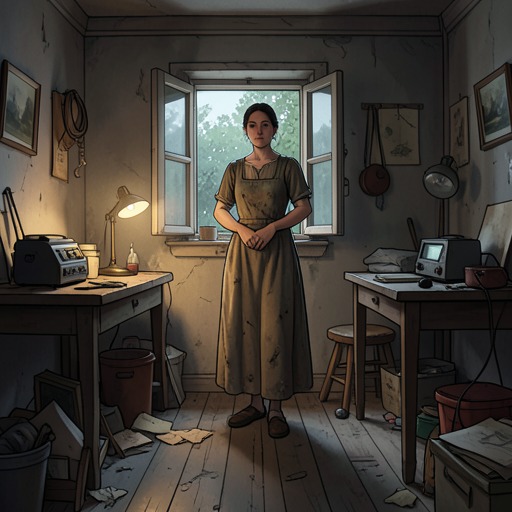
Louise Fowler
American WomanLouise Fowler, usually addressed as Mrs. Fowler, is a guide for the local historical society and a frequent presence at Dolly’s house. She brings visitors into the house’s history, but her more consequential role is social: she turns tours and tea into occasions for conversation, speculation, and attention. Her warmth is genuine, yet it can press against the privacy Jenny depends on while living there under the name Iris.
Identity and Public Role
Louise leads tours of Dolly’s house, where the guide’s knowledge ranges from architectural terms to the provenance of individual objects. On one tour, she and a visiting couple discover a shared fluency in obscure vocabulary such as porte cochere and rococo. Their mutual excitement makes them a little self-conscious about leaving the fourth member of their party out, so they repeatedly ask Frazer, who is using the name Mr. Jones, for his opinions on the gables and fish-scale shingles. Louise’s work is therefore not just recitation: she helps make the house a social experience, drawing visitors into discussion even when their interests do not match.
The tour also establishes that Dolly has opened the house to the public twice a week. Louise explains this as an act of generosity toward the community by its last surviving family member. Frazer, watching Louise take the three-dollar contributions for upkeep, privately suspects the money may instead help pay for groceries; the house appears to him to have little upkeep. That suspicion belongs to Frazer, not to any confession by Louise, but it complicates the polished public account she helps present. The tours gather money and visitors around a house whose hospitality exists alongside evident financial strain.
Tea, Tours, and Local Curiosity
Louise’s connection with the house extends beyond guiding tours. She regularly comes for tea, an occasion that Dolly and Jenny often try to avoid in their different ways. Dolly tends to disappear when Louise is giving a tour, which is one reason Louise so often comes to tea. The ritual is carefully arranged: Jenny boils the water, prepares the cookies and milk, sets out sugar with tongs, and carries the tray to the porch. Louise’s visits make her part of the household’s routines, although the people sharing those routines do not always welcome her excitement equally.
Her manner at tea is notably inquisitive. When Jenny returns late, Louise has a note from a visitor who has asked about her and come back with a pretext about wanting advice on painting his house. Louise reads his questions as signs of admiration and tells Jenny that she could tell he had met her before. She says she is a canny reader of men, and playfully proposes that she and Dolly could steam the envelope open. She immediately makes clear that she is teasing and would not do so. The exchange captures the mixture that defines her presence: she treats other people’s private lives as inviting material for conversation, but she also recognizes a boundary and insists that she has not crossed it.
Jenny and the Name Iris
Louise’s interest becomes more pointed because Jenny is living at the house under the name Iris. Jenny has long suspected that Louise imagines her through a collection of aesthetic stereotypes: rock gardens, tea ceremonies, and slender bamboo writing tools. Jenny also believes Louise is waiting for her to endorse Louise’s own cultivated taste in Asian arts. The text presents this as Jenny’s reading of Louise, not as an explicit statement of Louise’s intentions; nevertheless, it shows how Louise’s friendliness is entangled with assumptions about the woman she is trying to know.
Louise has interpreted Jenny’s avoidance as a kind of remote, mysterious reserve. When Jenny arrives at the porch, Louise announces that she has had a visitor and leans into the moment, eager to learn where Jenny met him. She points out that Jenny seems to have no friends, seldom goes out, and does little except shop for paint. Her questions are not detached: Louise pushes Jenny gently but firmly back into her chair when she tries to stand and leave with the envelope. She calls on Dolly to help make Jenny tell the story, turning curiosity into a small social ambush.
Character and Narrative Function
Louise’s eagerness to include people is visible even in the tour with Frazer. She and the couple are pleased to have found one another’s company, then feel guilty about their shared enthusiasm and try to bring him in. At tea, the same impulse takes a different form: she wants to draw Jenny into the household conversation and treats Jenny’s secrecy as a mystery to solve. Her friendliness is not presented as simple malice, but it can still become pressure. The episode makes the cost of ordinary sociability legible for someone who needs to remain unnoticed.
Louise is also a foil to Dolly’s quieter authority. When Louise’s excitement gathers force around Jenny and the letter, Dolly cuts across it by reminding Jenny of their room-and-board agreement. Jenny acknowledges the agreement, and the reminder establishes that her place in the house comes with conditions. Louise may host the teasing and curiosity, but Dolly can end the exchange by invoking the arrangement that governs Jenny’s stay. Louise’s scenes thus connect public welcome, intimate intrusion, and the practical limits of Jenny’s refuge: the house is open to visitors, and its social life is difficult for a hidden person to evade.